Yes, it's that time of year again. A time to get into the car and drive for 13 hours on Friday, arrive at Zion for the weekend, then hop back in the car on Monday to drive another 13 hours home. Still, it was a lovely trip. The weather was amazing (but a bit too hot for my taste). Gourmet food, wine, and cocktails were brilliant as always. Camping in tents and no showering for a couple of days.
And, best of all, fantastic friends. Click on the picture to enjoy the photo album.
"It's all [her] fancy, that: [s]he hasn't got no sorrow, you know," said the Gryphon.
Showing posts with label Travel. Show all posts
Tuesday, October 18, 2011
Monday, May 02, 2011
Road Trip to the Desert (Joshua Tree): The Pictures
![]() |
| Near Joshua Tree National Park |
We drove to Reno, Nevada then down US 395 to Pioneertown, California, about 10 miles from Joshua Tree National Park, across the 10 freeway near Pasadena, California, up US 5 over the Grapevine in Southern California back to San Francisco.
Tuesday, April 05, 2011
2010 Europe Trip: Research For My Novel - Nuremberg
The main reason I went to Europe last year was to do research for my historical novel. It's set in Nuremberg in the 1830s and is based on the true story of Kaspar Hauser, a young man who wandered into town one day. He appeared to not understand anything around him, including what people were saying. Eventually he was taken to the jail tower, then was taken in by a doctor who examined and educated him. Kasper said he had been kept in a cell for most of his life and had never been outdoors nor did he have interactions with anyone else, other than minimal contact with his jailer. The day he wandered into town he'd been released with no explanations.
That's all I'll say about him for now. You can click on the link if you want more info. As I said my story is based on him but I'm taking quite a few liberties with my novel though it generally follows most of the major events of his later life.
I spent all my time in the Altstadt (or old town) in the historic city center. Nuremberg was heavily bombed during the war and was subsequently rebuilt using the same building materials. The Altstadt is surrounded by a wall with the Kaiserburg (Nuremberg Castle) at the north end.
Of course Nuremberg is known for being the site of the Nuremberg trials and the infamous Nazi conventions and rallies. I made it a point to learn about Nazi Germany before my visit because I was concerned I would become distracted by this infamous history and wanted to be able to focus solely on my research.
I decided on some goals for this visit:
A map of the Altstadt. These maps are all over the historic city center and are very useful for staying oriented even if they're all in German. The Altstadt is quite a small area, you can walk from one end to the other in less than an hour.
I started by walking to the Kaiserburg and taking a slow walk around the Castle. The weather was gorgeous while I was there, even a bit warmer than I'd planned for, and encouraged a leisurely pace.
Part of the Gardens.
As I walked along taking pictures, I realized I was having problems with the idea of this scene happening here. First, I didn't know what kind of access mere mortals would have to these places even if they were well-connected, and secondly, the scene is a conversation between Kasper and his servant. It requires quiet and privacy and I didn't know if that would be possible in this place. It felt too public to me.
I was going to sign up for a tour of the inside of the Castle but realized it wouldn't be necessary since there are no scenes there. I decided it would be far more important for me to climb the stairs of the Sinwell Tower (jail tower) where I believe Kasper was kept when he first arrived in the city.
After wandering around and taking more pictures I stopped at Albrecht Dürer's House, a very popular museum across the street from the Castle. Dürer is one of Nuremberg's most famous sons and was a brilliant artist. I like to refer to him as the rock star of Northern Renaissance art. As I took the audio tour I wondered if I'd found my house but it just didn't feel right.
One of the lovely rooms in Dürer's house.
One of the defining characteristics of the house in my novel is it has to be large. Only three men are living there, not including the servants, but multiple floors and at least two sets of staircases are critical. It's difficult to explain why this is so since there's no practical reason for it but the psychological effect of living in such a house is very important for the characters and Dürer's house felt too cramped to me.
As part of my research on the city's history I walked to Fembo House, not far from the Kasierburg, a historic house which is also the city museum.
Fembo House from the front.
I learned a lot about the city's history and, most important, I'd found the house for my novel. The tour starts on the top floor and there were only two couples around. They left the floor very quickly and I slowly strolled through the rooms taking in all the exhibits and reading each sign carefully. When I was done with the exhibits I continued strolling around and around the floor going in and out of the rooms. I was letting the feel of the top floor sink in, listening to the sound of my steps, noting the air temperatures, and how the light looks in the rooms. I found out later that the top floor is where the servants live and where storage is kept. I was really happy I took so much time up there.
This room on the floor below was used as a ballroom during parties. It has its own dining room outside the door and there's a small kitchen behind me.
The first thing I noticed when I walked down to the next floor is the ceilings are quite a bit lower than we're used to and the doorways are low. This is important. Two of my characters are fairly tall, including one of my main characters. His notable physical characteristics includes his height, his posture, and the way he moves through space. He tends to be calm and has a certain grace about the way he moves, and he has perfect posture. In order for these characteristics to work, I can't have him awkwardly trying to get the through the doorway because they are too low so he can't be very tall. My other character is more secondary and it would actually make sense if he were a bit awkwardly tall, at least for this house.
The floors are creaky, you make noise wherever you walk. This is very important because this means you can hear someone coming even if you can't see them, even if it's too dark in the room.
As required, this house has two sets of stairs. I love these back stairs. I spent a lot of time walking up and down to get a feel for them. I should have taken some video.

More rooms on the floor below. I learned quite a bit about the layout of this style of architecture though I don't learn what the style is called. I need to do more research about that.
Fembo House is located next to other buildings and narrow winding cobblestone streets so there's no garden or stables. There is a courtyard as you can see in the picture above. Not having a garden meant I would have to do some tweaking of scenes during my next rewrite but not having stables and horses was a problem. One of my favorite secondary characters is the Stable Master. I thought about changing his occupation but it just wasn't working. The man was practically born to ride and take care of horses. The smell of horse is seeped into his bones, and the way he walks and his outlook on life points towards his occupation. I knew I had to come up with another idea. Fortunately, the Imperial Stables are right up the street and I knew they would have rented a space there.
This brochure about Fembo House is in German but is extremely useful. You can see my notes on the layout of the floors. There are good photos of the rooms too.
I visited another house later that day, Tucher Mansion, and it has similar architecture though on a much grander scale. The English version of their brochure is very short, only a few pages, and has no pictures but it gives a detailed layout of the different floors and how they were used.
I was going to go back to Fembo House the next day but didn't. I should have so I could have taken more pictures and walked around some more.
I had several maps of Nuremberg but used this one since it was the most detailed for my purposes. I used this map to figure out the route Kasper took when he first arrived in the city and to understand where Fembo House (no. 14 on the map) was in relation to the main square.
Fembo House is located right down the street from the Hauptmarkt, the Alstadt's largest square. There are farmers markets there most days, as there have been for centuries. Since coming back from my trip I've revised some of my scenes so they take place here.
A view of the Gate from the outside looking into the Altstadt.
The view looking down from the little garden looking towards the Kaiserburg.
I started to wonder if my walk in the snow actually takes place in the snow. According to my current timeline the earliest the walk can take place is sometime in late October, maybe early November, and I don't think it's snowing yet. I'll have to check the historical weather records. The snow isn't that important but it would make the atmosphere a little more magical.
So why go through all this? Why bother going all the way to Europe to do research on a novel that might never get published? And why bother looking for a real house to set the story in? Wouldn't it be easier to make all this up? The answer for me is no, it's not easier. True, I have a good imagination, and I could say I'm doing this because this story is based on a real person but I'm certain that I would do the same thing with all my stories if I could whether they're based on history or not. The reason is because I'm too locked into my own mindset and I make too many narrow assumptions about what a place could and should be like. The original draft of this novel was also set in a large house but the architecture was completely different and not even close to accurate. This has a profound affect on the story and the characters. Finding real places to base my settings on helps me go deeper into the story world.
Also, I've noticed when I write a story my characters and their relationship to the space around them and the setting is very important because it affects how they are. Because most of the novel takes place inside the house this is doubly true. Even many of my settings in my strange story on my Fainting in Coils blog, FailSafe, were based on real places.
I'm very happy I'd found what I was looking for on this visit. I was in Nuremberg for three days and spent all my time strolling around the Altstadt. I took a side trip to Ansbach, about 30 km away. This small town is the setting for the last part of my novel. The point was to get to know these towns and I felt I did just that. I'd really like to go back to Nuremberg in December during the Christmas Market for a couple of days and then spend at least 2-3 days in Ansbach again.
That's all I'll say about him for now. You can click on the link if you want more info. As I said my story is based on him but I'm taking quite a few liberties with my novel though it generally follows most of the major events of his later life.
I spent all my time in the Altstadt (or old town) in the historic city center. Nuremberg was heavily bombed during the war and was subsequently rebuilt using the same building materials. The Altstadt is surrounded by a wall with the Kaiserburg (Nuremberg Castle) at the north end.
Of course Nuremberg is known for being the site of the Nuremberg trials and the infamous Nazi conventions and rallies. I made it a point to learn about Nazi Germany before my visit because I was concerned I would become distracted by this infamous history and wanted to be able to focus solely on my research.
I decided on some goals for this visit:
- Learn about the history of the city (before the 1830s and until 1871 when the unification of Germany occurred).
- Spend a lot of time walking around and getting a good feel for the place.
- Find a house. Much of my novel takes place inside a house. Kasper lived in a different house at the time when my story takes place so I'm taking liberties here.
- Find the location for a pivotal outdoors scene, what I've dubbed "The Walk in the Snow."
- Find the location of where he came into the city and the place where he was found and attempt to retrace his steps.
I started by walking to the Kaiserburg and taking a slow walk around the Castle. The weather was gorgeous while I was there, even a bit warmer than I'd planned for, and encouraged a leisurely pace.
As I walked along taking pictures, I realized I was having problems with the idea of this scene happening here. First, I didn't know what kind of access mere mortals would have to these places even if they were well-connected, and secondly, the scene is a conversation between Kasper and his servant. It requires quiet and privacy and I didn't know if that would be possible in this place. It felt too public to me.
I was going to sign up for a tour of the inside of the Castle but realized it wouldn't be necessary since there are no scenes there. I decided it would be far more important for me to climb the stairs of the Sinwell Tower (jail tower) where I believe Kasper was kept when he first arrived in the city.
After wandering around and taking more pictures I stopped at Albrecht Dürer's House, a very popular museum across the street from the Castle. Dürer is one of Nuremberg's most famous sons and was a brilliant artist. I like to refer to him as the rock star of Northern Renaissance art. As I took the audio tour I wondered if I'd found my house but it just didn't feel right.
One of the defining characteristics of the house in my novel is it has to be large. Only three men are living there, not including the servants, but multiple floors and at least two sets of staircases are critical. It's difficult to explain why this is so since there's no practical reason for it but the psychological effect of living in such a house is very important for the characters and Dürer's house felt too cramped to me.
As part of my research on the city's history I walked to Fembo House, not far from the Kasierburg, a historic house which is also the city museum.
I learned a lot about the city's history and, most important, I'd found the house for my novel. The tour starts on the top floor and there were only two couples around. They left the floor very quickly and I slowly strolled through the rooms taking in all the exhibits and reading each sign carefully. When I was done with the exhibits I continued strolling around and around the floor going in and out of the rooms. I was letting the feel of the top floor sink in, listening to the sound of my steps, noting the air temperatures, and how the light looks in the rooms. I found out later that the top floor is where the servants live and where storage is kept. I was really happy I took so much time up there.
The first thing I noticed when I walked down to the next floor is the ceilings are quite a bit lower than we're used to and the doorways are low. This is important. Two of my characters are fairly tall, including one of my main characters. His notable physical characteristics includes his height, his posture, and the way he moves through space. He tends to be calm and has a certain grace about the way he moves, and he has perfect posture. In order for these characteristics to work, I can't have him awkwardly trying to get the through the doorway because they are too low so he can't be very tall. My other character is more secondary and it would actually make sense if he were a bit awkwardly tall, at least for this house.
The floors are creaky, you make noise wherever you walk. This is very important because this means you can hear someone coming even if you can't see them, even if it's too dark in the room.
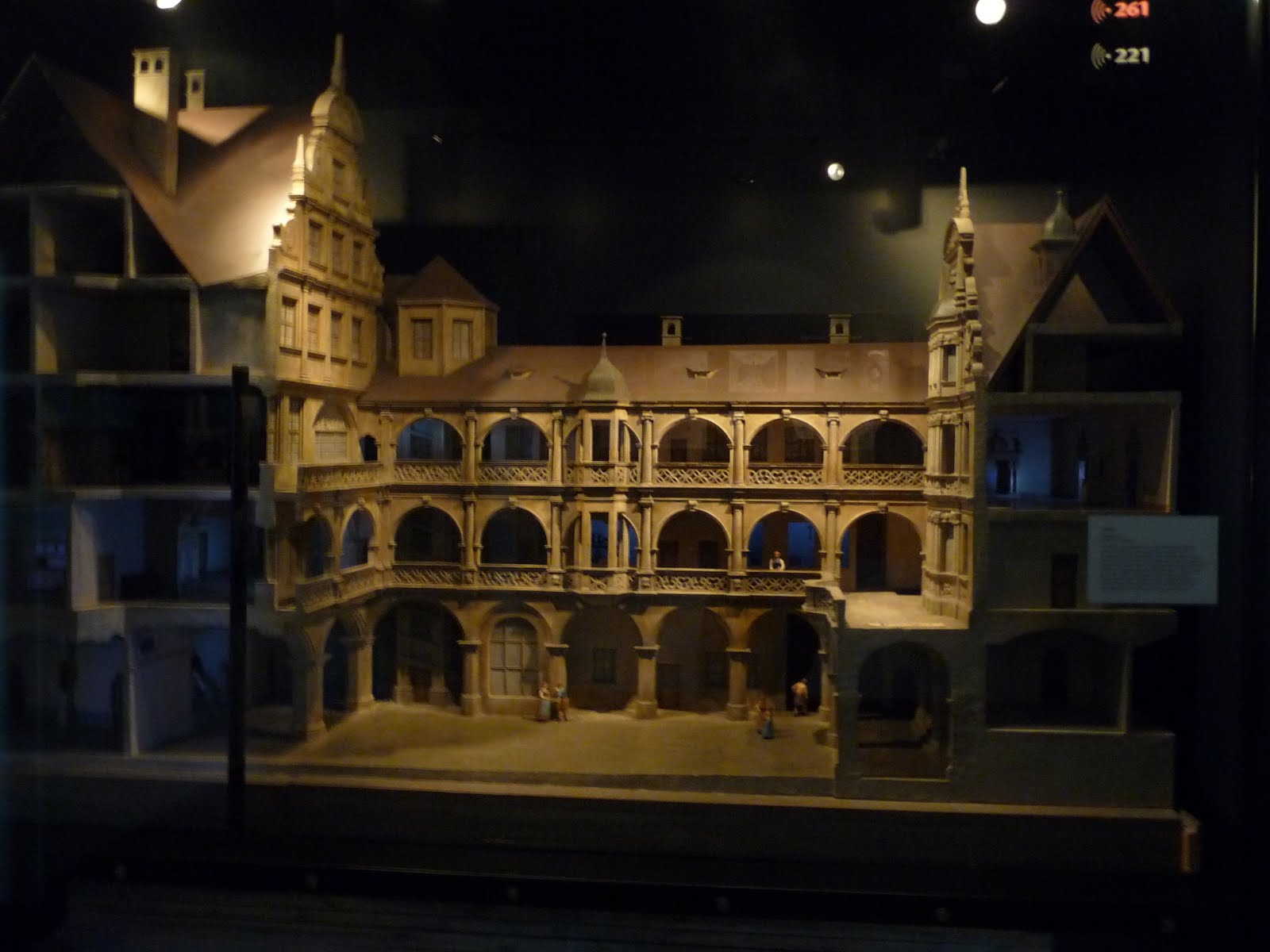
This model of a house with similar architecture was very useful for visualizing the house as a whole though this version is larger than Fembo House. Ground floor is the entrance hall, first floor are the bedrooms, second floor are the best rooms in the house, rooms for greeting guests, etc., the third floor is where the ballroom is located, fourth floor, only a section of the floor, houses the servants.
Fembo House is located next to other buildings and narrow winding cobblestone streets so there's no garden or stables. There is a courtyard as you can see in the picture above. Not having a garden meant I would have to do some tweaking of scenes during my next rewrite but not having stables and horses was a problem. One of my favorite secondary characters is the Stable Master. I thought about changing his occupation but it just wasn't working. The man was practically born to ride and take care of horses. The smell of horse is seeped into his bones, and the way he walks and his outlook on life points towards his occupation. I knew I had to come up with another idea. Fortunately, the Imperial Stables are right up the street and I knew they would have rented a space there.
I visited another house later that day, Tucher Mansion, and it has similar architecture though on a much grander scale. The English version of their brochure is very short, only a few pages, and has no pictures but it gives a detailed layout of the different floors and how they were used.
I was going to go back to Fembo House the next day but didn't. I should have so I could have taken more pictures and walked around some more.
Fembo House is located right down the street from the Hauptmarkt, the Alstadt's largest square. There are farmers markets there most days, as there have been for centuries. Since coming back from my trip I've revised some of my scenes so they take place here.
The Hauptmarkt, also the site of the world famous Christmas Markets.
I was happy I'd found the house but still hadn't found the site for my "Walk in the Snow" scene. I'd decided to find the square Kasper was found in (and it wasn't the Hauptmarkt like I originally thought) and attempt to retrace the path he took to get there.
Kasper came in through the Neutor, or the New Tower Gate. There are Baroque Gardens right across the street, and I thought perhaps I would go there to see if my "Walk in the Snow" scene could take place there but I found something much, much better.
I was happy I'd found the house but still hadn't found the site for my "Walk in the Snow" scene. I'd decided to find the square Kasper was found in (and it wasn't the Hauptmarkt like I originally thought) and attempt to retrace the path he took to get there.
Kasper came in through the Neutor, or the New Tower Gate. There are Baroque Gardens right across the street, and I thought perhaps I would go there to see if my "Walk in the Snow" scene could take place there but I found something much, much better.
I walked along the top of the city wall behind the Gate which is really nice. Lots of shady trees, places to sit, and a mini-garden. Most of Nuremberg is surrounded by the huge, beautiful wall and I think you can walk along parts of it.
I started to wonder if my walk in the snow actually takes place in the snow. According to my current timeline the earliest the walk can take place is sometime in late October, maybe early November, and I don't think it's snowing yet. I'll have to check the historical weather records. The snow isn't that important but it would make the atmosphere a little more magical.
So why go through all this? Why bother going all the way to Europe to do research on a novel that might never get published? And why bother looking for a real house to set the story in? Wouldn't it be easier to make all this up? The answer for me is no, it's not easier. True, I have a good imagination, and I could say I'm doing this because this story is based on a real person but I'm certain that I would do the same thing with all my stories if I could whether they're based on history or not. The reason is because I'm too locked into my own mindset and I make too many narrow assumptions about what a place could and should be like. The original draft of this novel was also set in a large house but the architecture was completely different and not even close to accurate. This has a profound affect on the story and the characters. Finding real places to base my settings on helps me go deeper into the story world.
Also, I've noticed when I write a story my characters and their relationship to the space around them and the setting is very important because it affects how they are. Because most of the novel takes place inside the house this is doubly true. Even many of my settings in my strange story on my Fainting in Coils blog, FailSafe, were based on real places.
I'm very happy I'd found what I was looking for on this visit. I was in Nuremberg for three days and spent all my time strolling around the Altstadt. I took a side trip to Ansbach, about 30 km away. This small town is the setting for the last part of my novel. The point was to get to know these towns and I felt I did just that. I'd really like to go back to Nuremberg in December during the Christmas Market for a couple of days and then spend at least 2-3 days in Ansbach again.
Thursday, February 24, 2011
2010 Europe Trip: Ghent - An Art Side Trip
Ghent is a city in Belgium and about a 30 minute train ride from Bruges. I originally thought I'd take a day trip to Brussels and Ghent but I only had one day. After considering the pros and cons I decided to go to Ghent.
I'd read about both Ghent and Bruges when I was in my early 20s in Conde Nast's Traveler which had recently been relaunched. The article was very short, a blurb really, comparing Bruges with Ghent. It said that Ghent is often overlooked in favor of Bruges. This might be true for many travelers but the primary reason I chose Ghent over Brussels was so I could see some key pieces of art.
When I arrived at the train station I found the tram to downtown after asking some locals. Ghent is a modern city with an amazing city center of medieval buildings. As we drew closer to downtown, however, I realized the city was in the middle of a massive restoration project. All of the streets and sidewalks of the downtown area were being torn up and redone. It was a mess.
A view of the downtown construction.
It quickly became clear that I wasn't going to do much walking around. If that's all I'd come for I would have been disappointed but I came to see the art so all was not lost.
I started at the Sint-Baafs Cathedral (you can see it in the above picture looking down the street) to see the main event, The Ghent Altarpiece or the Adoration of the Mystic Lamb by the van Eyck brothers (started by Hubert, who died while working on it, and finished by his brother Jan). This polyptych was completed in 1432. The altarpiece is 11 x 15 feet. Yes, that means it takes up an entire wall. I knew the painting was undergoing a major restoration but they said I could still see it and watch the restorers at work.
The restorers were housed behind a glass wall with various tables and computers, lights, cameras, and other instruments. They were working on Adam and the singing angels in the upper left corner, and the two panels of knights in the lower left corner. The rest of the main altarpiece was still on the wall. Restorers were making notes and taking pictures of it. The two panels of knights were right in front of the glass wall so I could get a good look at them. I stood there for over an hour, watching and looking. People came and went, including crowds of tour groups. Most were there for two minutes or less. There was one couple who stayed for perhaps 15 minutes before leaving. When I was taking my class of Lower Medieval to High Renaissance Art, I was completely amazed by this altarpiece the first time my teacher showed us the slide. I vowed that I would someday see it in person. At the time it seemed like such an impossible dream. Now that I was there I was really going to look at it.
I noticed the archangel Gabriel was leaned up against the wall behind the closest restorer who was sitting at a desk with a lot of camera and computer equipment. I couldn't really see Gabriel with all the stuff in the way, plus he had a green strap hanging over his precious face. Though I can't draw faces at all I decided to stretch myself a little and draw him.
Gabriel is part of the back side panels which close over the main part of the altarpiece. He's in one panel with Mary in the other next to him in a depiction of the Annunciation.
A photo of the back of my postcard showing the back side panels. You can see Gabriel there on the upper right side and Mary opposite him on the left.
Gabriel was a tough, tough draw. Because he was behind the restorer leaned up against the wall on the floor, I had to stand on my tip toes to get a decent look at him. The restorer noticed I was trying to draw him and was kind enough to turn on a light near him so I could see better. Also, I was really intimidated because this was a treasured masterpiece by the van Eyck brothers with all its glorious attention to minute details. Still, I was very happy I made the attempt. One of the many cool things I liked about Gabriel was his traditional rainbow wings look like the cross section of a watermelon with the same kind of texture.
I reluctantly left the altarpiece and strolled around the cathedral. There's a Rubens there as well though I can't remember which one. I didn't take any pictures of the inside of the cathedral. I went outside and wandered around the main part of the historic city center as much as I could but the torn up streets and heavy equipment motoring around made me think twice so I made my way back to the tram.
The street restoration project should be finished sometime next year, if memory serves me correctly. When they're done I'm sure the city center will be gorgeous.
I took the tram back to the train station then inquired about where I could find the Citadelpark, a lovely park where there are several museums, among other things. It was very close to the train station, maybe 2-3 blocks away. I was on my way to the Museum voor Schone Kunsten to specifically to see two paintings by my favorite painter, Hieronymous Bosch. As an aside, I wrote an essay a couple of years ago entitled The Role of Extreme Violence in Art where I talk about Bosch, among others, and why I love him so much.
A very beautiful park. No one was around. I think I saw two people on my way to the museum.
Sun, trees. I can't get enough of these kinds of photos.
The museum was larger than I expected and again, no one was around. They had a special exhibit going on but I elected not to see it. The art I was looking for was in the second room I walked into. There they were: Christ Carrying The Cross and Saint Jerome At Prayer.
I LOVE this painting and spent a long time looking at it. There was no one in that part of the museum, not even the security guards. Sadly, the painting was in need of restoration. I decided to try drawing another face and chose the grotesque face in the lower right corner of the painting. Since his features were so exaggerated I thought it might be easier. It wasn't. I particularly had a difficult time with his nose, getting it in proportion to his face and in the correct shape.
On another wall in the same room was Saint Jerome. I was really tired by then and decided to go the easy route and just draw his robe. I've gotten much more comfortable drawing draped fabric.
You can see the robe I drew draped over the tree log on the right.
As the post-it tag notes, this is my sixth Bosch.
I walked through the rest of the museum and only saw three other people. The museum is a kind of a maze with different levels and sub-levels. It seemed like it was organized in a half-circle shape. I kept getting lost and couldn't figure out which direction I was moving in. This proved to be fun because I kept walking into rooms with interesting art, particularly when I got to the 20th Century section.
I eventually found my way out and walked back to the train station where I caught the next train back to Bruges. My back, shoulders, neck, arms and hands were hurting, sketching is a painful activity for me. It was late afternoon in Bruges and folks were out in force in all the outdoor cafes. The walk back was good for me and my feet had finally gotten used to the cobblestones.
I'd read about both Ghent and Bruges when I was in my early 20s in Conde Nast's Traveler which had recently been relaunched. The article was very short, a blurb really, comparing Bruges with Ghent. It said that Ghent is often overlooked in favor of Bruges. This might be true for many travelers but the primary reason I chose Ghent over Brussels was so I could see some key pieces of art.
When I arrived at the train station I found the tram to downtown after asking some locals. Ghent is a modern city with an amazing city center of medieval buildings. As we drew closer to downtown, however, I realized the city was in the middle of a massive restoration project. All of the streets and sidewalks of the downtown area were being torn up and redone. It was a mess.
It quickly became clear that I wasn't going to do much walking around. If that's all I'd come for I would have been disappointed but I came to see the art so all was not lost.
I started at the Sint-Baafs Cathedral (you can see it in the above picture looking down the street) to see the main event, The Ghent Altarpiece or the Adoration of the Mystic Lamb by the van Eyck brothers (started by Hubert, who died while working on it, and finished by his brother Jan). This polyptych was completed in 1432. The altarpiece is 11 x 15 feet. Yes, that means it takes up an entire wall. I knew the painting was undergoing a major restoration but they said I could still see it and watch the restorers at work.
I noticed the archangel Gabriel was leaned up against the wall behind the closest restorer who was sitting at a desk with a lot of camera and computer equipment. I couldn't really see Gabriel with all the stuff in the way, plus he had a green strap hanging over his precious face. Though I can't draw faces at all I decided to stretch myself a little and draw him.
Gabriel is part of the back side panels which close over the main part of the altarpiece. He's in one panel with Mary in the other next to him in a depiction of the Annunciation.
Gabriel was a tough, tough draw. Because he was behind the restorer leaned up against the wall on the floor, I had to stand on my tip toes to get a decent look at him. The restorer noticed I was trying to draw him and was kind enough to turn on a light near him so I could see better. Also, I was really intimidated because this was a treasured masterpiece by the van Eyck brothers with all its glorious attention to minute details. Still, I was very happy I made the attempt. One of the many cool things I liked about Gabriel was his traditional rainbow wings look like the cross section of a watermelon with the same kind of texture.
I reluctantly left the altarpiece and strolled around the cathedral. There's a Rubens there as well though I can't remember which one. I didn't take any pictures of the inside of the cathedral. I went outside and wandered around the main part of the historic city center as much as I could but the torn up streets and heavy equipment motoring around made me think twice so I made my way back to the tram.
The street restoration project should be finished sometime next year, if memory serves me correctly. When they're done I'm sure the city center will be gorgeous.
I took the tram back to the train station then inquired about where I could find the Citadelpark, a lovely park where there are several museums, among other things. It was very close to the train station, maybe 2-3 blocks away. I was on my way to the Museum voor Schone Kunsten to specifically to see two paintings by my favorite painter, Hieronymous Bosch. As an aside, I wrote an essay a couple of years ago entitled The Role of Extreme Violence in Art where I talk about Bosch, among others, and why I love him so much.
The museum was larger than I expected and again, no one was around. They had a special exhibit going on but I elected not to see it. The art I was looking for was in the second room I walked into. There they were: Christ Carrying The Cross and Saint Jerome At Prayer.
I LOVE this painting and spent a long time looking at it. There was no one in that part of the museum, not even the security guards. Sadly, the painting was in need of restoration. I decided to try drawing another face and chose the grotesque face in the lower right corner of the painting. Since his features were so exaggerated I thought it might be easier. It wasn't. I particularly had a difficult time with his nose, getting it in proportion to his face and in the correct shape.
As the post-it tag notes, this is my sixth Bosch.
I walked through the rest of the museum and only saw three other people. The museum is a kind of a maze with different levels and sub-levels. It seemed like it was organized in a half-circle shape. I kept getting lost and couldn't figure out which direction I was moving in. This proved to be fun because I kept walking into rooms with interesting art, particularly when I got to the 20th Century section.
I eventually found my way out and walked back to the train station where I caught the next train back to Bruges. My back, shoulders, neck, arms and hands were hurting, sketching is a painful activity for me. It was late afternoon in Bruges and folks were out in force in all the outdoor cafes. The walk back was good for me and my feet had finally gotten used to the cobblestones.
Monday, November 08, 2010
2010 Europe Trip: Bruges - The Medieval City
Bruges is a perfectly preserved medieval city in Belgium. I'd read about Bruges years ago but it wasn't until after I saw the movie "In Bruges" that I decided I really had to visit the place. In addition to its weirdness and relentless profanity, the film really showcases the city.
I had an interesting reaction about Bruges from that weird couple from Toronto I talked to while in Amsterdam. When I told them I was going to Bruges, the wife said, "Bruges! I had a friend who went there and she said it was completely over the top. I'd never even heard of Bruges before she went." She went on to admit that she didn't exactly know what her friend meant by "being over the top" but she'd assumed it was a negative reaction. She also said visiting a medieval city held no interest for her. I mentioned that the historic city center is a UNESCO World Heritage site, and she scoffed at this fact saying "EVERYTHING is a UNESCO World Heritage site so that doesn't mean anything at all." Her husband and that guy from the midwest both agreed with her. She asked me why I would want to go there and I explained that I loved Northern Renaissance art, a comment that had everyone in the room stumped. I changed the subject and took everything she said with a grain of salt. After all, this is a women who announced to everyone she couldn't see why ANYBODY thought Van Gogh had talent. Now, I can understand people not caring much for his art, we all have our preferences, but I couldn't see how she could make a statement like that.
Okay, back to the city. Bruges has a small city center and can be seen easily in one day. I spent a little less than two days here and it was a nice amount of time though if you ask me for a recommendation I think three days would be really lovely.
A view of the Markt (market square) from one of the many surrounding cafes. The tall building is the Belfort (belfrey). I was there during their Pride weekend though I drank too much beer and ended up sleeping through their Pride Parade. Still, when I arrived in town and saw the rainbow flags up at the Markt I was really tickled.
My Bed and Breakfast is just around that corner. This street is about a block and a half from the Markt.
Bruges is a pricey town. While my bed and breakfast was reasonably priced (about $80 a night), the restaurants were expensive. Of course, there are cheaper places to eat, street vendors and such, but I noted there were plenty of upscale, beautiful restaurants, tea houses, cafes, etc. I had an absolutely decadent Belgium waffle with chocolate and strawberries along with some tea at the cafe in the picture above and it cost over $20 when I did the conversion.
Here it is, the $20 Belgium waffle and tea. Was it worth it? I think so. The quality of the chocolate was out of this world and the strawberries were super sweet but I still have to admit that I was a surprised when I got the bill.
Chocolate. The best chocolate I've ever had was here (including white chocolate). There are chocolate shops all over the place and it didn't take me long to pick one so I could buy some for souvenirs. I bought two boxes, one for my Dad and one for the folks at work. The chocolate was handmade that week with fresh ingredients. While this chocolate doesn't last as long because there are no preservatives, nothing tastes better. It was beautiful. The ladies at the shop said you can buy boxes of their chocolate at stores but the ingredients aren't fresh so it tastes different.
There are plenty of beautiful gift shops as well. Bruges only has a handful of tacky gift shops around the Markt. The rest of the shops are all upscale designer type stores. Yep, Bruges caters to folks who have money. I'm not saying you can't go there on a budget, you just have to be aware and plan accordingly.
Not surprising, Bruges is all cobblestones. If you're not used to walking on them they're killer on your feet so make sure you bring supportive, broken in shoes. I'd brought my cute leather clogs but had to switch to my white sneakers. I didn't get used to the cobblestones until my trip was almost over.
Here I am in front of one of the canals in this place. There aren't as many as in Amsterdam but they're still beautiful. Note the touristy white sneakers.
A proper picture of the canal from the bridge above.
A view of the Markt from one of the lower floors of the Belfort. They were doing renovations at the top so I didn't get a shot of the Markt from there.
Here's the shot of the view I was able to get. This view is from back side of the Belfort.
As I mentioned in my photo comments, this trip was all about climbing stairs. Climbing the Belfort was quite something and the stairs get steeper and narrower as you get closer to the top. They thoughtfully provide a rope for you to hang on to. I met a young man from Kentucky who was visiting his sister in Brussels as I made my way down. I asked him if he wanted to go ahead of me since I was taking a long time but he said he didn't mind. We had a nice conversation about our travels.

Bruges is well known for its swans and they tend to hang out at the Minnewater, a canalized lake, also called the Lake of Love. There's a legend about the swans (go here) which explains why Bruges is supposed to keep swans for eternity. I missed two opportunities to take a canal cruise so I opted for a carriage ride instead. The carriage ride was expensive but worth it.
The driver took me to the Minnewater and let me (and the horse) relax for about 20 minutes.
Miss Turtle at the Minnewater. I spent quite a bit of time observing the swans: two of them were nesting. I probably should have been walking around taking more pictures but the swans were mesmerizing.
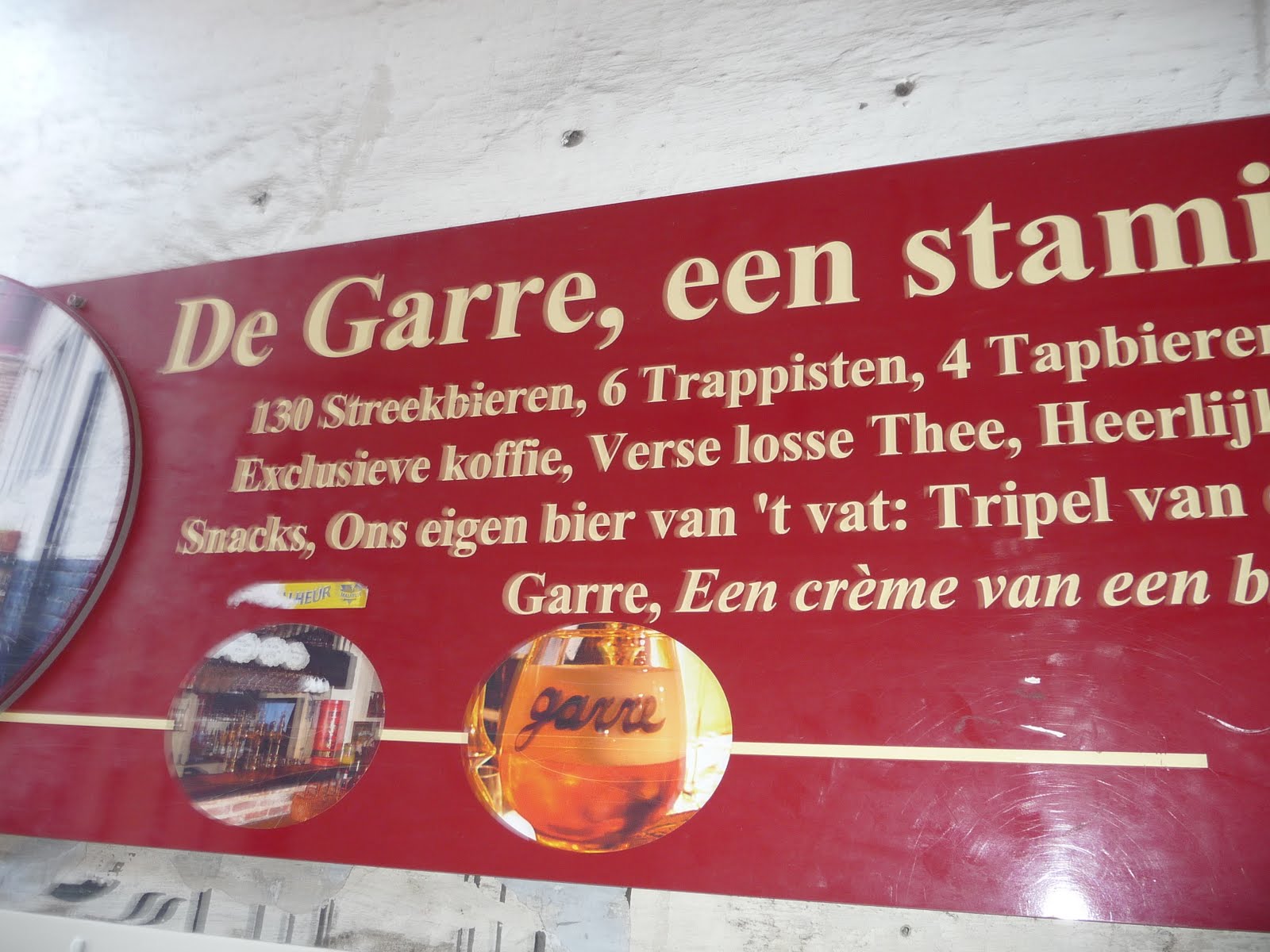
The carriage ride was worth it in other ways. The driver pointed out a narrow alley in Bruges, right off the Markt which didn't look like an alley, more like a space between two buildings. Down this alleyway is a legendary beer bar, Staminee de Garre, which has over 100 beers. Apparently, tourists prowl around the Markt looking for the elusive alleyway and walk right by it because it's so narrow. He showed me right where it was and after my carriage ride I went for a drink.
The alleyway looking towards the street. It's incredibly easy to miss it because it doesn't look like anything. Mostly locals hang out here.
11% alcohol. Very strong tasting. Comes with soft white cheese, and that's not a beer glass, people, it's a beer bowl. I drank the entire thing. I'm not a beer drinker but it was incredible.
I learned that beer in Amsterdam and certainly in Bruges is much, much better than beer here in the U.S. American beers, even if they're imported, taste like watered down crap and have no complexity to them. Bruges is known for having the best beer in the world. If I hadn't been traveling alone I would spent a lot more time drinking in all the places I visited. I almost never drink beer at home but if I do I tend to like Guinness Stout.
The sign for the beer bar near the front of the alley. I might have been a little tipsy when I took this picture.
As I've been writing this post I really do think I would have preferred to be here for at least three days, maybe even three and a half. Bruges is a small city but there's so much walking and strolling to do, and the city encourages you relax, sit at an outdoor restaurant or cafe, and watch the world go by.
I had an interesting reaction about Bruges from that weird couple from Toronto I talked to while in Amsterdam. When I told them I was going to Bruges, the wife said, "Bruges! I had a friend who went there and she said it was completely over the top. I'd never even heard of Bruges before she went." She went on to admit that she didn't exactly know what her friend meant by "being over the top" but she'd assumed it was a negative reaction. She also said visiting a medieval city held no interest for her. I mentioned that the historic city center is a UNESCO World Heritage site, and she scoffed at this fact saying "EVERYTHING is a UNESCO World Heritage site so that doesn't mean anything at all." Her husband and that guy from the midwest both agreed with her. She asked me why I would want to go there and I explained that I loved Northern Renaissance art, a comment that had everyone in the room stumped. I changed the subject and took everything she said with a grain of salt. After all, this is a women who announced to everyone she couldn't see why ANYBODY thought Van Gogh had talent. Now, I can understand people not caring much for his art, we all have our preferences, but I couldn't see how she could make a statement like that.
Okay, back to the city. Bruges has a small city center and can be seen easily in one day. I spent a little less than two days here and it was a nice amount of time though if you ask me for a recommendation I think three days would be really lovely.
Bruges is a pricey town. While my bed and breakfast was reasonably priced (about $80 a night), the restaurants were expensive. Of course, there are cheaper places to eat, street vendors and such, but I noted there were plenty of upscale, beautiful restaurants, tea houses, cafes, etc. I had an absolutely decadent Belgium waffle with chocolate and strawberries along with some tea at the cafe in the picture above and it cost over $20 when I did the conversion.
There are plenty of beautiful gift shops as well. Bruges only has a handful of tacky gift shops around the Markt. The rest of the shops are all upscale designer type stores. Yep, Bruges caters to folks who have money. I'm not saying you can't go there on a budget, you just have to be aware and plan accordingly.
Not surprising, Bruges is all cobblestones. If you're not used to walking on them they're killer on your feet so make sure you bring supportive, broken in shoes. I'd brought my cute leather clogs but had to switch to my white sneakers. I didn't get used to the cobblestones until my trip was almost over.
Even with my interest in medieval art I have to admit I didn't realize what medieval architecture was about. I'd never studied it before other than what I'd seen as background in paintings so I had a wonderful time walking around the city and noting it's beautiful buildings. Bruges was never bombed so the historic city center is completely and wonderfully intact.
Some buildings on the Markt. The large gray building is the Provinciaal Hof (Provincial Court). The red brick building on the right is the post office where I mailed a bunch of clothes home in a desperate bid to lighten my luggage.
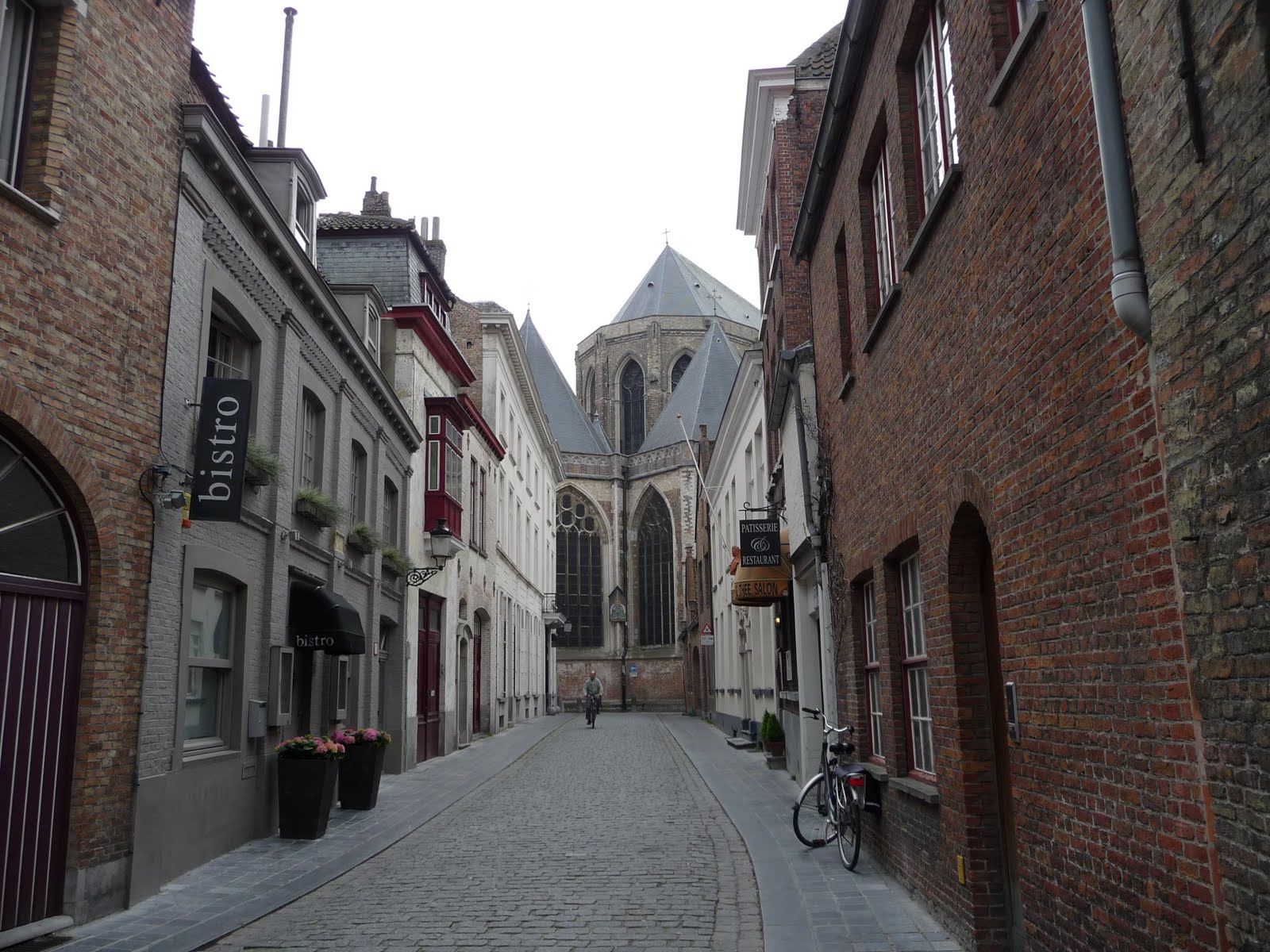
The back of the Sint Salvator's Cathedral. While smaller than the Church of Our Lady (and lacking a Michelangelo), I still loved this church. It felt so good to be here. I don't know why. I was here for a long time and I couldn't stop touching the walls.
The interior of Sint Salvator's. I actually kissed one of the pillars before leaving. It was my weird way of saying thank you (and I left a small donation).
Since Bruges is so small you could easily walk to the train station from the city center (about a 15-20 minute walk) but if you have a lot of luggage I suggest you take the bus instead. The bus stop was just a few steps away from my B&B. When I took my side trip to Ghent, I walked to the train station. It was a beautiful walk and I had fun because I followed a group of school kids going on a field trip to the station.
Bruges is well known for its swans and they tend to hang out at the Minnewater, a canalized lake, also called the Lake of Love. There's a legend about the swans (go here) which explains why Bruges is supposed to keep swans for eternity. I missed two opportunities to take a canal cruise so I opted for a carriage ride instead. The carriage ride was expensive but worth it.
The carriage ride was worth it in other ways. The driver pointed out a narrow alley in Bruges, right off the Markt which didn't look like an alley, more like a space between two buildings. Down this alleyway is a legendary beer bar, Staminee de Garre, which has over 100 beers. Apparently, tourists prowl around the Markt looking for the elusive alleyway and walk right by it because it's so narrow. He showed me right where it was and after my carriage ride I went for a drink.
I'd mentioned in the photos that I'd walked into the pub and, not knowing what kind of beer to order, requested a recommendation. The man at the bar suggested the "house beer" known as Tripel de Garre. I remember thinking I was going to get gyped into some subpar beer but I was wrong, of course. I included this shot in the photos I uploaded to Picasa but just have to post it here again.
I learned that beer in Amsterdam and certainly in Bruges is much, much better than beer here in the U.S. American beers, even if they're imported, taste like watered down crap and have no complexity to them. Bruges is known for having the best beer in the world. If I hadn't been traveling alone I would spent a lot more time drinking in all the places I visited. I almost never drink beer at home but if I do I tend to like Guinness Stout.
As I've been writing this post I really do think I would have preferred to be here for at least three days, maybe even three and a half. Bruges is a small city but there's so much walking and strolling to do, and the city encourages you relax, sit at an outdoor restaurant or cafe, and watch the world go by.
Subscribe to:
Posts (Atom)